Historical Record · Dublin, c.1910
Westmoreland Street Photography — Stanley’s Dublin Studio Portrait, c.1910
Stanley Studio, 22 Westmoreland Street
Catalogue details
Description
An original cabinet-card portrait from one of central Dublin’s most historically important photographic addresses — preserved with its unusually elaborate studio mount and decorative reverse.
- Date
- c.1910; probably 1909–1911
- Place
- 22 Westmoreland Street, Dublin, facing O’Connell Bridge
- Country
- Ireland
- Category
- Irish Photography
- Photographer
- Stanley, Dublin
- Extent / Pages
- 1 mounted photographic card · recto and verso
- Dimensions
- Measurements gladly provided on request
- Subject
- Unidentified woman, head-and-shoulders portrait
- Studio negative / reference
- 45-3329 · handwritten on verso
- Medium
- Original mounted studio photograph in cabinet-card format
- Condition
- Please consult the photographs for condition. Additional photographs are available on request.
Shipping quoted by destination before payment
Historical context & sources
Context, attribution and documentary significance.
The Studio
A portrait made on Dublin’s photographic mile.
Westmoreland Street and the streets running north towards Sackville Street and south towards Grafton Street formed the heart of Dublin’s professional photographic trade. The Lauder family — among the best-known names in Irish studio photography — operated at several addresses on this route, which the Dictionary of Irish Biography describes as the city’s “photographic mile”.
This card gives its address explicitly: 22 Westmoreland Street, facing O’Connell Bridge. A directory-based chronology places Stanley at that address in 1909–1911; from 1912 the listing changes to “Stanley, J. E. and Lauder”. Royal Museums Greenwich independently records a Stanley cabinet portrait taken at 22 Westmoreland Street in 1910. Taken together with the card’s use of the Stanley name alone, those records make a date around 1910 — and most probably within 1909–1911 — the strongest working attribution.

Dublin, c.1910 · The Time Capsule
A city of formal portraiture, electric trams and a new moving-image culture.
The portrait belongs to a Dublin poised between the nineteenth-century studio tradition and a rapidly changing modern city. By the 1911 census Dublin had a population of roughly 305,000. Westmoreland Street was one of its busiest central arteries: electric trams, horse-drawn vehicles, cyclists and pedestrians converged around O’Connell Bridge, only steps from Stanley’s door.
Photography was no longer the city’s newest visual technology. In December 1909 the Volta Electric Theatre opened on Mary Street with James Joyce briefly involved in its management, and in 1910 The Lad from Old Ireland became the first film made in Ireland. A woman entering Stanley’s studio at this moment was therefore participating in an older, carefully staged portrait culture at exactly the point when motion pictures were beginning to alter the way Dubliners encountered images.
The elegance of the portrait should not be mistaken for a complete picture of the city. The same 1911 world contained extreme housing inequality: Dublin City Council’s historical research records tens of thousands of families living in tenements, many in single rooms. The cabinet card captures one deliberate public presentation of a life; the city beyond the studio door was far more socially complex.
The Portrait
Respectability, fashion and the language of the studio.
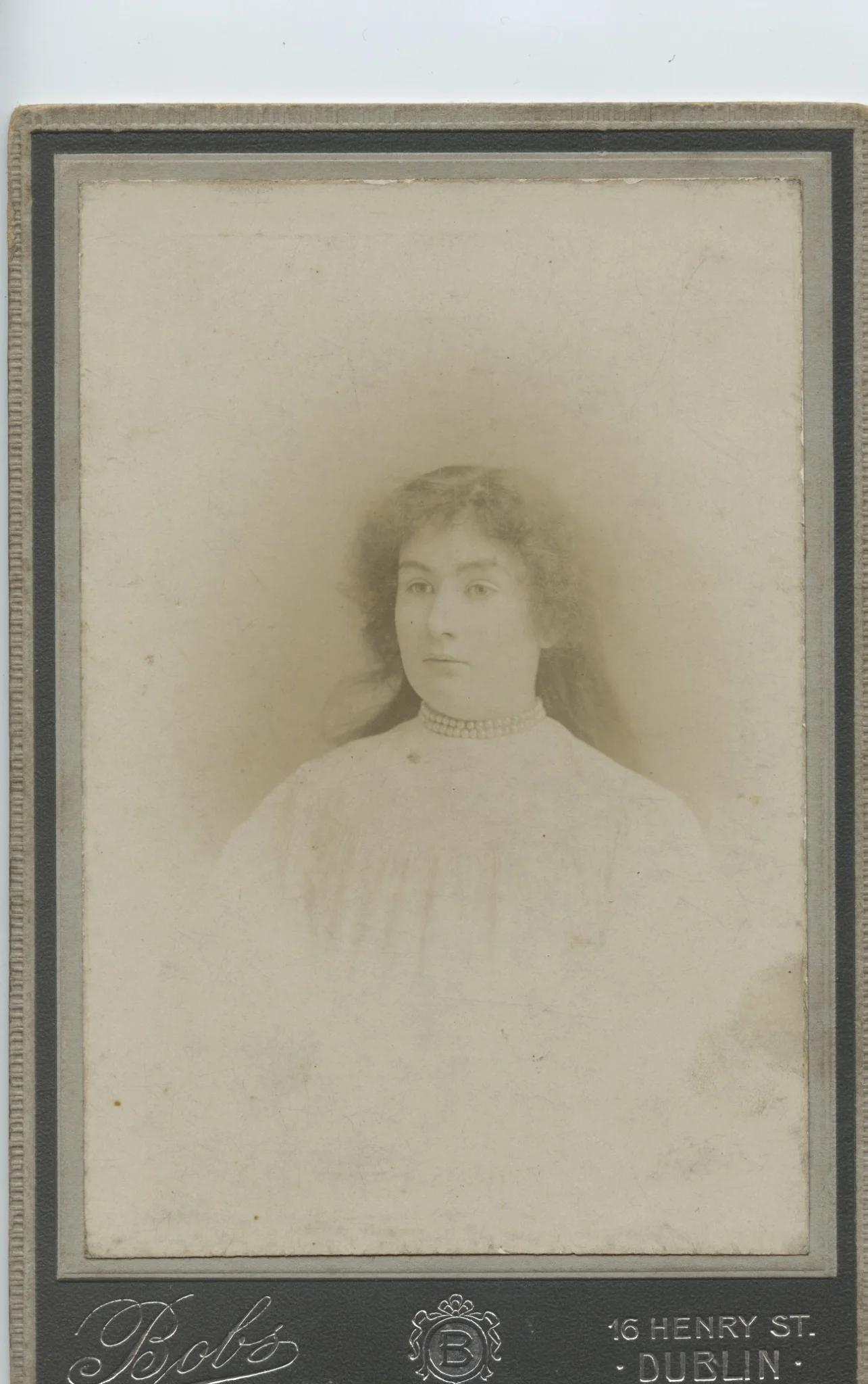
The sitter is unidentified. She is shown from the shoulders upward, turned slightly toward the camera, wearing a short pearl necklace and a light dress or blouse with decorative lace or embroidered detail. Her hair is arranged in the broad, waved Edwardian style associated with the years around 1910.
The photographer has reduced the setting almost to nothing. There are no props, painted architecture or furniture: the emphasis is on face, hair, jewellery and dress, with the lower body dissolving softly into the pale ground. The effect is intimate but formal — exactly the sort of image intended to circulate within a family rather than document everyday life.
At the lower right of the photograph, the Stanley name is impressed into the image area. The portrait’s restraint contrasts sharply with the reverse, where the studio advertised itself through a dense red design of butterflies, climbing foliage, winged putti, an easel and palette.
The Address
22 Westmoreland Street — facing O’Connell Bridge.
The address is part of the object’s historical value. The present building at the junction of Westmoreland and D’Olier Streets was completed in 1898 for the London & Lancashire Fire Insurance Company. Buildings of Ireland records it as a conspicuous Gothic-baronial landmark directly opposite O’Connell Bridge.
Long before its later association with the Lafayette name, the address had been embedded in Dublin photography. Earlier nineteenth-century operators also worked from 22 Westmoreland Street, and the surrounding district remained one of the city’s most competitive locations for professional portrait studios. A studio card carrying this address therefore links the anonymous sitter not simply to “Dublin”, but to a precise commercial and visual geography at the centre of the city.
Dating & Survival
The card itself narrows the window.
Stanley photographs survive in institutional collections. Royal Museums Greenwich records a 1910 cabinet card from the 22 Westmoreland Street studio; Louth County Archives catalogues another mounted female portrait by Stanley at the same address and explicitly records a handwritten number on its reverse. The present card carries the handwritten studio/reference number 45-3329. No online institutional match for that exact number was located in the sources checked.
This is therefore not presented as a unique surviving Stanley photograph. Its interest lies in the combination of a strong portrait, the studio’s short “Stanley” address phase around 1909–1911, and a remarkably decorative reverse that preserves the studio’s full commercial identity. The dating is research-based rather than inscribed, and remains deliberately expressed as c.1910.
This catalogue record treats the photograph as a time capsule rather than an isolated portrait. Research consulted includes Dictionary of Irish Biography, Royal Museums Greenwich, Buildings of Ireland, National Archives of Ireland — Dublin in 1911, and the National Library of Ireland’s Eason Photographic Collection.