Historical Record · Dublin · 1904
Inside Edwardian Dublin Medicine — Richard Atkinson Stoney’s Personal Diary, 1904
Dublin Medical & Surgical Working Diary, 1904
Catalogue details
Description
STONEY, Richard Atkinson (1877–1966). N. J. Powell’s One-Day Diary for 1904. London: N. J. Powell & Co., Ltd., 101 High Street, Whitechapel, 1904.
- Dimensions
- Measurements gladly provided on request
- Date
- 1904
- Place
- Dublin, Ireland
- Category
- Irish Manuscripts · Medical History
- Country
- Ireland
- Format
- Printed one-day pocket diary with manuscript entries
- Owner / Writer
- Richard Atkinson Stoney (1877–1966)
- Condition
- Please consult the photographs for condition. Additional photographs are available on request.
Tracked shipping quoted by destination
Historical context & sources
Catalogue Description
STONEY, Richard Atkinson (1877–1966). N. J. Powell’s One-Day Diary for 1904. London: N. J. Powell & Co., Ltd., 101 High Street, Whitechapel, 1904. Original black textured binding, the upper cover lettered in gilt The One Day Diary; extensively used in manuscript by Stoney during 1904. The volume carries multiple internal marks of ownership and provenance, including “Dr Stoney / 115 Lower Baggot St. / Dublin”, “R. Atkinson Stoney / 115 Lower Baggot St. Dublin”, and an earlier presentation inscription reading “R.A.S. / from L.H.G. / Xmas 1903”.
This is a personal working document rather than a later memoir. Its dated entries place Stoney inside the daily medical culture of Edwardian Dublin at a formative point in his career, with operation lists, hospital appointments, professional meetings and private engagements appearing together on the same pages.
An original working diary kept by Dublin surgeon Richard Atkinson Stoney (1877–1966) during the first full year after his appointment as surgeon to the Royal City of Dublin Hospital — documenting operations, hospital life, professional meetings, travel and the research subject that became his 1904 paper on the visceral pelvic fascia.
Manuscript Images & Rights
Why the manuscript pages are shown only as limited previews
This diary is an unpublished historical manuscript. Because rights in the handwritten text may still subsist, Ten Bells Auction House deliberately does not publish complete readable page reproductions or an extensive transcription online. The interior images below are reduced catalogue previews: they are provided to establish the nature, extent and condition of the original object and to illustrate selected areas of research interest, not to reproduce the diary as a facsimile or digital edition.
The restriction applies to the online reproduction, not to the physical manuscript. The original diary offered here is the physical manuscript volume described in this catalogue record. Serious prospective purchasers and institutions may request additional photographs specifically for condition and acquisition assessment, subject to applicable rights.
Why This Diary Matters
It preserves the working year in which a young Dublin surgeon was beginning the career for which he later became nationally prominent.
A Securely Identified Primary Source
The attribution is internal, repeated and contemporary.
The volume is not attributed to Stoney merely because of subject matter or later provenance. His identity is written into the object more than once: “Dr Stoney / 115 Lower Baggot St. / Dublin” and “R. Atkinson Stoney / 115 Lower Baggot St. Dublin”. A presentation inscription, “R.A.S. / from L.H.G. / Xmas 1903”, places the diary in his possession immediately before the year for which it was printed.
The initials “L.H.G.” have not yet been identified and are deliberately left unresolved. This distinction between documented fact and open research is part of the catalogue record.
The Date Is Crucial
1904 was the first full year after Stoney’s appointment as surgeon to the Royal City of Dublin Hospital.
Stoney graduated from Trinity College Dublin in 1901 after serving at the Royal City of Dublin Hospital as a student and intern. The hospital’s own historical record states that he was elected surgeon in 1903, succeeding Henry Gray Croly. This diary therefore captures him not at the end of a celebrated career, but at its beginning — aged twenty-six and twenty-seven, already responsible for operative work in a major Dublin hospital.
The same hospital history records 1904 as a period of technological change: electric lighting was completed throughout the hospital and a new X-rayist was appointed. Stoney’s manuscript sits directly inside that moment in the modernization of Dublin hospital medicine.
For collectors and researchers, this places the manuscript at the intersection of Dublin medical history, Edwardian surgery, the Royal City of Dublin Hospital (Baggot Street Hospital), Trinity College Dublin and the professional world of the Royal Academy of Medicine in Ireland.
Dublin in Stoney’s Working World
Two visual points of reference for the Baggot Street hospital environment.
The diary belongs to a specific medical landscape in Edwardian Dublin. The first photograph below is genuinely contemporary with Stoney’s 1904 diary; the second is a later CC0 view included to identify the surviving hospital building clearly.


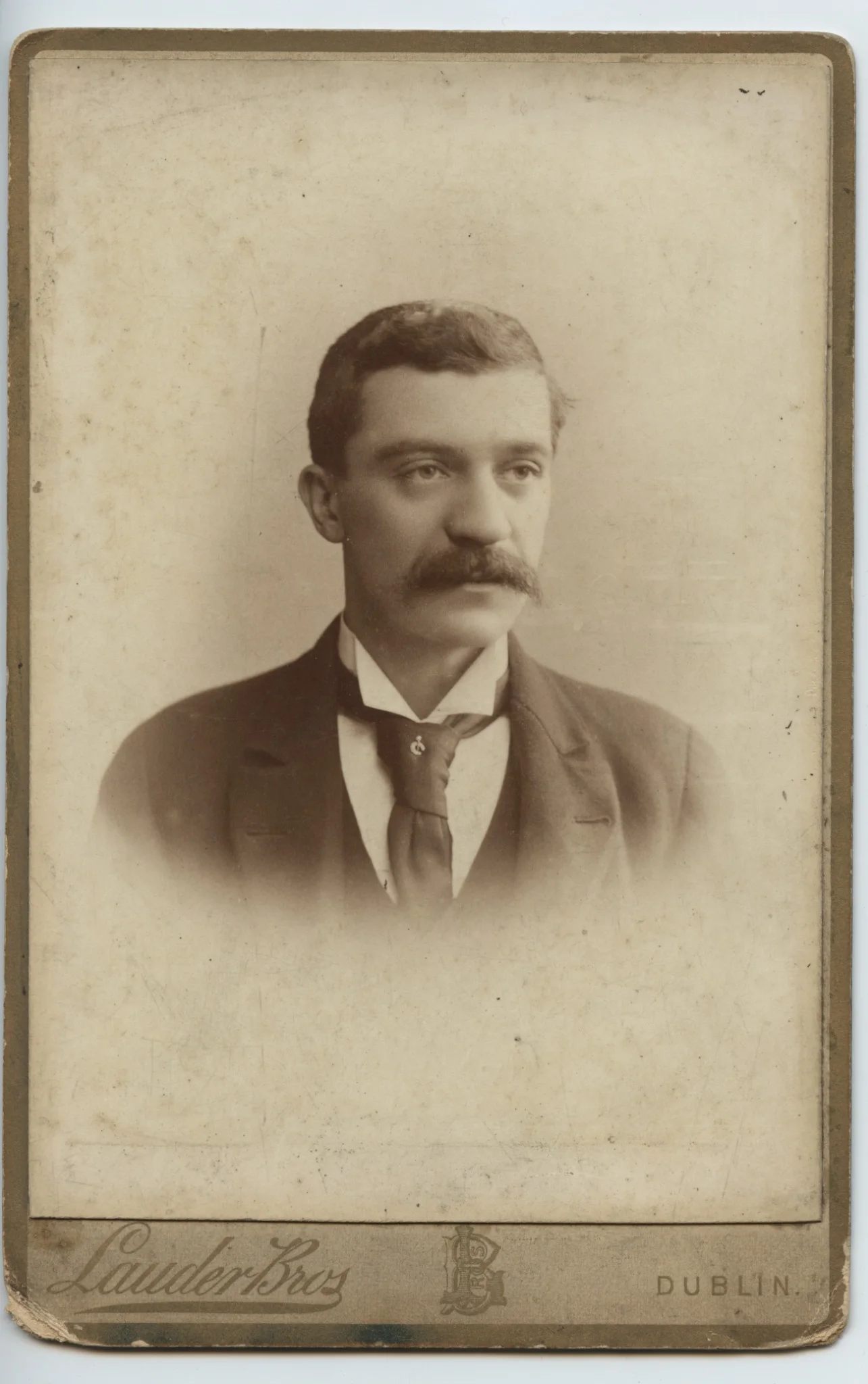
Image-use note. No portrait of Stoney has been reproduced here without a clear reuse basis. The Dictionary of Irish Biography records a portrait by David Hone as being in family possession; it is therefore not treated as a public-domain catalogue image.
Additional period reference. A Robert French photograph of the Royal City of Dublin Hospital, probably dated 9 November 1913 (NLI ref. L_IMP_4411), survives in the Lawrence Collection. It is cited for research but not reproduced here because the National Library of Ireland catalogue states that reproduction rights in its digital copy are owned by the NLI. NLI catalogue record →
Manuscript to Publication
A January entry appears to catch Stoney’s pelvic-fascia research in motion.
On 29 January 1904 Stoney records a Royal Academy of Medicine engagement together with a note concerning the anatomy of the pelvic fascia. In July of the same year, the Journal of Anatomy and Physiology published Stoney’s paper The Anatomy of the Visceral Pelvic Fascia, identifying him with both the Royal City of Dublin Hospital and Trinity College Dublin.
This is one of the diary’s strongest documentary features. The manuscript does not merely establish that Stoney practised surgery in 1904; it preserves a dated reference to the same anatomical subject that entered the published medical literature only months later. The diary therefore provides a tangible link between his professional calendar, Dublin medical society activity and his early published research.
Clinical Practice
The operation lists show the range of surgery entering one young surgeon’s working week.
The diary includes repeated surgical entries rather than isolated medical references. On 30 January Stoney lists removal of inguinal glands and treatment of a sinus in the abdominal wall. The 26 November spread records an appendicectomy, a plastic operation for syndactyly and further operative measures. On 3 December he records removal of tubercular glands of the neck and removal of an epithelioma of the lip; a fee of £2/2/- appears on the same page.
These concise notes are valuable precisely because they were written for use, not for publication. They preserve the vocabulary, scheduling and case mix of surgical practice in Edwardian Dublin without the retrospective editing of memoir or biography.
Professional and Personal Dublin
The volume is more than a case book.
Hospital dinners, Royal Academy of Medicine business, appointments, journeys and recreation sit beside operative lists. A late-August spread records a 144-mile journey and bicycle polo. Other pages note social engagements and professional meetings. This mixture gives the diary a wider historical value: it documents how hospital practice, medical networks and ordinary private life overlapped for a young Dublin surgeon in 1904.
For researchers, that makes the object useful across several fields — Irish medical history, the history of surgery, Dublin institutional history, professional networks and the material culture of everyday record-keeping.
The Later Career
The young surgeon represented here went on to become a major figure in Irish medicine.
Stoney was elected a Fellow of the Royal College of Surgeons in Ireland in 1906. During the First World War he served with the French medical services from 1915 to 1918 and was awarded the Légion d’honneur. His later surgical writing included work on gunshot injuries, wound treatment, tetanus and nerve suture.
He was elected to the RCSI council in 1924 and served as President of the Royal College of Surgeons in Ireland from 1930 to 1932. He subsequently served as President of the Royal Academy of Medicine in Ireland from 1933 to 1936. The diary predates those honours by nearly three decades, which is precisely what gives it biographical force: it records the working life behind the later institutional reputation.
Documentary & Collecting Significance
Its importance rests on convergence: named provenance, an early-career date, sustained clinical content and a direct research connection.
Age alone does not make this diary important. Its significance comes from several independent features occurring in one object: repeated contemporary identification of Stoney; a Christmas 1903 presentation inscription; use during his first full year as a Royal City of Dublin Hospital surgeon; substantial surgical content; participation in Dublin medical life; and the January reference to pelvic-fascia research that closely precedes his July 1904 publication on the same subject.
For a collector or institution, it is therefore both a personal manuscript and a professional medical document. It gives access to Stoney before the First World War, before his fellowship of the RCSI, and decades before his presidencies — while his clinical and academic identity was still being formed.
Selected Contents
Ten dated examples of what the diary documents.
The descriptions below are catalogue summaries, not transcriptions. They identify representative medical, institutional and personal content while deliberately avoiding publication of extended manuscript text.
Documented content. Stoney records a Royal Academy of Medicine engagement together with work on the anatomy of the pelvic fascia.
Why it matters. This is especially significant because in July 1904 Stoney published The Anatomy of the Visceral Pelvic Fascia in the Journal of Anatomy and Physiology. The dated diary entry therefore appears to preserve a contemporary trace of research that reached publication only months later.
Documented content. A Royal City of Dublin Hospital dinner appears alongside a numbered list of surgical work, including treatment involving the inguinal glands and an abdominal-wall sinus.
Why it matters. The page shows the diary operating as an immediate professional record rather than a retrospective memoir, combining institutional life and operative practice within a single day.
Documented content. The day includes a major breast operation and an evening engagement at Freemasons’ Hall, Molesworth Street.
Why it matters. The juxtaposition is historically useful because it places clinical work and Stoney’s social calendar inside the same contemporary record.
Documented content. Entries document Royal City of Dublin Hospital committee business and clinical duties.
Why it matters. These routine obligations help reconstruct Stoney’s institutional life during his first full year after appointment as surgeon to the hospital.
Documented content. A numbered operative list includes treatment of varicose veins together with additional abbreviated procedures.
Why it matters. The page provides evidence of the range of surgical work recorded by Stoney. Abbreviations that cannot be read confidently are deliberately left uninterpreted.
Documented content. A non-medical entry records a long journey of approximately 144 miles, severe weather and mechanical trouble.
Why it matters. Material of this kind broadens the diary beyond hospital history and preserves aspects of the everyday mobility and private life of an Edwardian Dublin surgeon.
Documented content. Across these days Stoney records Royal City of Dublin Hospital business, a knee procedure involving previously placed silver wire, and recreation at Howth.
Why it matters. The sequence demonstrates how the diary interweaves institutional, clinical and private activity rather than separating professional and personal life.
Documented content. One of the denser operative pages includes an appendicectomy and a plastic operation for syndactyly among other surgical work.
Why it matters. This is one of the clearest examples of the volume functioning as a concise working memorandum of active surgical practice.
Documented content. Consecutive entries connect treatment, duties at Trinity and hospital committee work.
Why it matters. Together they help reconstruct the range of responsibilities that could occur within an ordinary working week.
Documented content. The late-year entry records procedures involving tuberculous glands of the neck and an epithelioma of the lip, together with a monetary notation of £2/2/-.
Why it matters. The catalogue does not assign the monetary entry to a particular patient or service beyond what can safely be established from the manuscript.
Manuscript reproduction & rights note
This is an unpublished historical manuscript. Rights in the handwritten text may still subsist, so Ten Bells Auction House does not publish complete readable page reproductions or extended transcriptions online. Interior page images are intentionally reduced catalogue previews used to document the physical object, condition and representative content. They should not be understood as a facsimile, complete transcription or digital edition.
The online limitation does not indicate missing pages or an incomplete object. It is a publication policy concerning the manuscript text. Additional photographs for condition and acquisition assessment may be made available to serious prospective purchasers or institutions on request, subject to applicable rights.
Cataloguing note: manuscript readings are selective and conservative. Uncertain names or words have not been expanded speculatively; the descriptions summarise the surrounding content rather than reproducing the manuscript in full.
- Dictionary of Irish Biography — Richard Atkinson StoneyRoyal Irish Academy biographical record: Trinity College education, 1903 appointment to the Royal City of Dublin Hospital, First World War service, Légion d’honneur, RCSI presidency and Royal Academy of Medicine presidency.
- The Anatomy of the Visceral Pelvic Fascia, Journal of Anatomy and Physiology, July 1904Stoney’s 1904 paper, published only months after the diary’s January reference to “Anatomy of Pelvic Fascia”; author affiliations are Royal City of Dublin Hospital and Trinity College Dublin.
- Royal City of Dublin Hospital: 150th Anniversary, 1832–1982Institutional history recording Stoney’s election as surgeon in 1903 and developments at the hospital in 1904.
- RCSI Heritage Collections — Presidents of RCSIOfficial chronology recording Richard Atkinson Stoney as President of RCSI, 1930–1932.
- Thom’s Irish Who’s Who — Richard Atkinson StoneyPeriod biographical reference recording his qualifications, early academic posts and service as visiting surgeon at the Royal City of Dublin Hospital from 1903.
- National Library of Ireland on The Commons / Wikimedia Commons — Haddington Road, c.1902–1907Contemporary visual context for the Baggot Street hospital environment; the Commons record states “No known copyright restrictions”.
- Wikimedia Commons — Royal City of Dublin Hospital, Baggot StreetLater identifying photograph of the hospital building, released by its photographer under the CC0 1.0 public-domain dedication.