
Wiktor Emil Rylander and the Visual History of Swedish Beekeeping
An intact album attributed through its own internal evidence to the Blekinge schoolteacher and beekeeping writer Wiktor Emil Rylander opens a remarkably specific window onto Swedish biodling: meetings, travel, queen breeding, equipment manufacture and the networks that connected apiarists across the country between the late 1920s and the Second World War.
Institutional acquisition · October 2026
Collection update: The original Wiktor Emil Rylander photographic album has been acquired by Kungliga biblioteket, the National Library of Sweden. The original is held by KB; researchers wishing to consult it should contact the library. Ten Bells Auction House retains digital reference documentation.
A name inside an album
Historical albums are strongest when attribution comes from the object itself. In this case, one of the surviving cards is addressed directly to “Herr lärare W. E. Rylander – Sandbäck”. That documentary anchor sits alongside repeated beekeeping subjects, national meeting photographs, specialist contacts, travel views and industrial images.
The album therefore does not need a later owner’s guess to give it a name. Its internal structure points strongly to Wiktor Emil Rylander, a Swedish schoolteacher whose published work places him firmly within the history of Swedish apiculture and local history.
The collection contains 29 original photographs and three printed historical portraits. Its importance lies less in any single image than in the continuity between them: people, places, handwritten identifications, association gatherings and the material culture of beekeeping survive in one sequence.
Rylander the teacher and “biförfattare”
Rylander was not simply an amateur who happened to keep bees. A historical study of beekeeping in Blekinge describes the Sandbäck schoolteacher as a biförfattare — a writer on apiculture — and records that, beginning in 1917, he issued Biodlarnas fickkalender. The pocket calendar combined month-by-month practical advice with dated note pages, a flowering calendar for nectar plants, accounts and reference information for beekeepers.
The same source records Rylander as a frequent contributor to Bigården and Bitidningen between 1915 and 1921, publishing his own articles and translations from Danish and German beekeeping journals. That matters when reading the album: the photographs belong to a man already participating in a wider exchange of specialist knowledge.
Rylander’s interests were broader than apiculture. Bibliographic records preserve his local-history writing on Blekinge, including Ryssberget (1924), Vesan (1926) and Stompastugan (1929). The combination of teacher, writer, local historian and beekeeper helps explain why an album connected with him moves so naturally between technical subjects, landscapes and organised meetings.
Swedish beekeeping becomes a national network
The album’s dates are significant. Sweden’s national beekeeping movement had recently consolidated when these photographs were made. Sveriges Biodlares Riksförbund records that the two principal national organisations agreed to merge in 1919 and that the unified federation began operating on 1 January 1920.
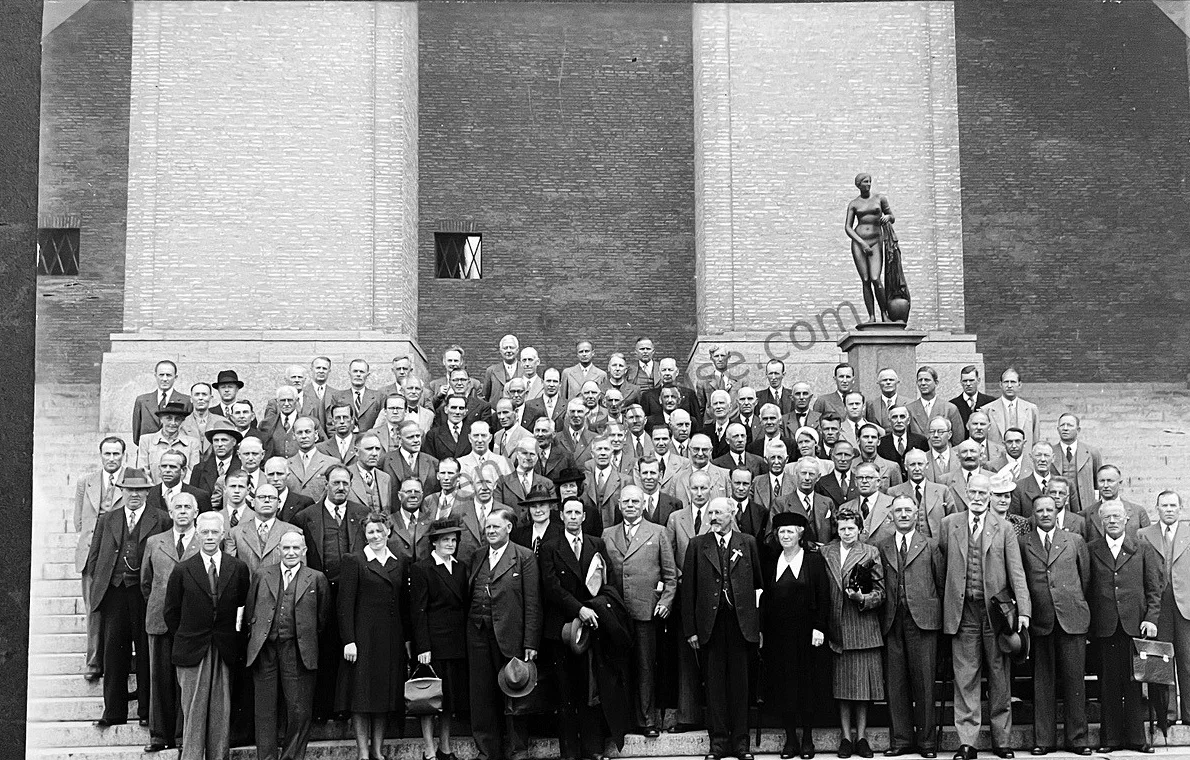
Rylander had already been writing for both sides of that earlier print culture. By the late 1920s, the national meetings photographed in his album belonged to a more unified organisational landscape. Large group portraits from Falun 1928, Falun 1934, Borås and Göteborg / Bohus 1944 are therefore more than souvenir photographs. Together they record the people who made up a specialist Swedish network over nearly two decades.
The faces are not all identified, and they should not be over-read. But the sequence itself is evidence: organised apiculture was not only a private rural practice. It involved associations, publishing, congresses, technical discussion and sustained personal contact.
Dalarna, Siljan and the geography of association life
A substantial travel sequence moves through Rättvik, Leksand, Mora / Morastrand, Hemus, Saxviken, Vika and Gesundaberget. Several versos preserve handwritten place names, allowing the route to be reconstructed with unusual precision.
Some of those views may relate to travel around the documented Falun meetings, but the album does not prove that every landscape photograph was made on a congress journey. The distinction is important. The strongest interpretation is that Rylander’s professional and association life generated travel, and that the album preserves both the formal gatherings and the landscapes encountered around them.
That mixture is one of the reasons the album works so well as a historical document. It does not separate “work” from “life” in the modern archival sense. A meeting group, a lake view, a postcard and a specialist contact can occupy the same personal record because they belonged to the same lived network.
Queen breeding, workshops and beekeeping material culture
One surviving card refers to a Drottningodlingsstation — a queen-breeding station — showing contact with specialist breeding rather than only domestic hive keeping. Elsewhere the album turns from people and landscapes to workers, timber, machinery and production.
Current research connects the workshop sequence with Bröderna Melins Biredskapsfabrik in Markaryd, a manufacturer of hives and other apicultural equipment. Association histories confirm that Melins equipment circulated among Swedish beekeepers in the period. The photographic attribution is still presented cautiously, because no single surviving caption conclusively names the factory.
Even with that caution, the workshop photographs are valuable. They remind us that the history of beekeeping is also the history of objects: boxes, frames, smokers, queen-rearing equipment, timber, tools and the small industries that supplied an expanding technical practice.
Why the album matters as a whole
It would be easy to remove the most visually impressive group photographs and sell them as isolated images of “Swedish beekeepers”. That would also destroy much of what makes them useful. The address card, the landscape sequence, the meeting photographs and the workshop views reinforce one another because they survive together.
The album has therefore been kept complete and undivided. Its research value comes from relationships: the same individual’s interests appear in publishing records, handwritten evidence, photographs and places. That coherence is precisely what a private album can preserve better than a folder of detached photographs.
The Wiktor Emil Rylander Collection is presently reserved for the National Library of Sweden in Stockholm. The public catalogue record remains intentionally selective; full page-by-page documentation and the research dossier stay with the collection.
Svensk sammanfattning: Wiktor Emil Rylander och svensk biodlingshistoria
Wiktor E. Rylander i Sandbäck var folkskollärare, biodlingsskribent och utgivare av Biodlarnas fickkalender från 1917. Den bevarade fotosamlingen dokumenterar svensk biodling, biodlarmöten, Falun, Göteborg och Bohus, Dalarna, drottningodling och biredskap under perioden cirka 1928–1944. Albumet bevaras som en sammanhållen historisk källa och kopplar fotografi till svensk föreningshistoria, lokalhistoria och biodlingens materiella kultur.
Related collection record
The Wiktor Emil Rylander Collection →
Institutional catalogue record with representative photographs, collection structure and current status.
Sources and further research
The album itself is the primary source for the photographic sequence and its internal associations. The following references support the biographical and historical context used here.
- Historical study of beekeeping in Blekinge — digital copy via Kulturhotell — identifies Wiktor E. Rylander of Sandbäck as a schoolteacher and beekeeping writer, records Biodlarnas fickkalender from 1917, and his contributions to Bigården and Bitidningen.
- Sveriges Biodlares Riksförbund — Vårt uppdrag och historia — official history of the national organisation and the 1919–1920 merger.
- Kalmar läns museum library catalogue — Wiktor E. Rylander — bibliographic records for Vesan (1926) and Stompastugan (1929).
- Gösta Ottervik, Litteratur om Blekinge (1941) — bibliographic record identifying Wiktor Emil Rylander as author of Ryssberget.
- Sigtunaortens biodlarförening — association history — documents the circulation of equipment from Bröderna Melins Biredskapsfabrik in Markaryd.