Ten Bells Auction House · Institutional Acquisition Record
Berlin · Italy · France · Austria · Argentina · 1927–1938 · later biographical research to Canada, 1941
The Meyerhof Family Archive — Jewish Family Life Across Europe, 1927–1938
A coherent German-Jewish family and personal archive centred on the Meyerhof and Werner circles, preserving original photographs, negatives, correspondence, documents and named photographic packets from Berlin, Italy, France, Austria and Argentina, with later biographical research extending to Canada.
Institutional enquiryInstitutional acquisition onlyMuseums · Libraries · Archives · Research Institutions. The archive is offered intact and will not be dispersed.
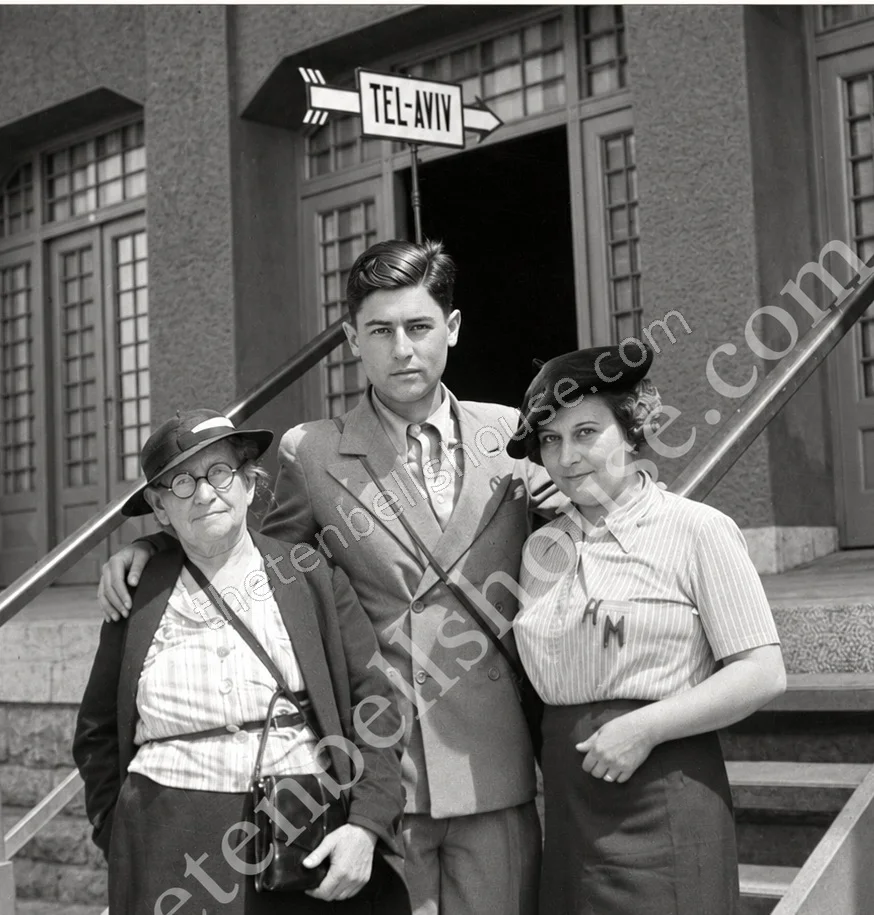
Representative family photograph from the Meyerhof material. The present research identifies the central young man as Heinz-Lothar Meyerhof; the identification remains provisional pending independent image-level corroboration.
Date1927–1938
PlaceBerlin · Italy · France · Austria · Argentina
CategoryPrivate Archives & Collections
CountryGermany · Italy · France · Austria · Argentina
DimensionsFull archive-level measurements on request
Catalogue ReferenceTBH-ARC-MEYERHOF-1927-1938
StatusInstitutional acquisition only
Archive summary
An internally coherent fonds in which photographs, documents and original packet associations remain connected.
The archive brings together original photographs, negatives, photographic packets, letters, documents and scientific material. Its principal institutional value lies in the survival of those relationships: names, dates, places, laboratory markings and correspondence can still be read within the structure in which the material was preserved.
This page is a curated preview only. It is designed to interest museums, libraries, archives and recognised research institutions without distributing the full research file online.
Institutional acquisition
Available on institutional enquiry.
Institutions only · no private sale
Public display here
Selected representative examples
Detailed review
Master inventory and dossier on request
Acquisition terms
Price on request · institutional enquiry only
Hold option
Possible during committee review or purchase order stage
94original photographic prints
258photographic negatives
21original packets / envelopes
12postcards
4letters
2documents
Description & Historical Context
The significance lies in the survival of the archive as a connected body of evidence.
The working inventory records 392 physical archival components. Rather than a set of isolated photographs, the fonds preserves relationships between prints, negatives, original processing packets, handwriting, dates, correspondence and named individuals. The material was acquired together in Ireland and has remained together rather than being assembled from separate purchases.
The archive connects several fields of potential institutional interest: German-Jewish family history, refugee and migration history, vernacular photography, Jewish maritime history, inter-war Italy, and the history of medicine and science. Some identifications remain provisional; confirmed documentary facts and research hypotheses are deliberately distinguished throughout the dossier.
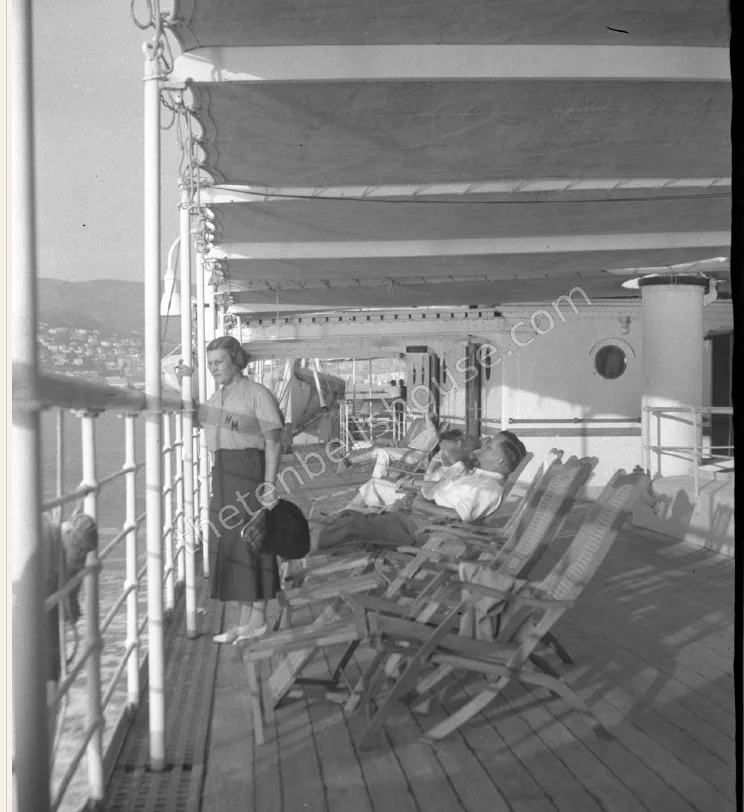
N7 · “Sommerreise – Juli 1935” · S.S. Tel Aviv. Original shipboard negative from the preserved multi-frame maritime sequence. External sources independently document the vessel’s 1935 Trieste–Haifa service; the precise port and individual passenger identities remain under research.
Chronology
Berlin, Italy, the Mediterranean and Argentina.
The documentary chronology begins in Berlin in 1927 with a Jewish family document connected in the working inventory with Heinz-Lothar Meyerhof and his mother. The photographic packets then move through Italy and neighbouring regions: Rome, Milan, Lago Maggiore, Como/Lugano, Stelvio, Venice and related travel groups. A Paris packet bears the Meyerhof name.
By July 1935 a substantial packet preserves a multi-frame S.S. Tel Aviv sequence — vessel, deck/passenger and embarkation views. In 1937 the archive reaches Buenos Aires through dated photographs, followed in November 1938 by migration-related correspondence from Banfield, Argentina.
Migration & Jewish history
Migration correspondence and the documentation of displacement.
The 1938 Banfield correspondence discusses practical migration matters including permission, financial guarantees, consular procedure and visas. It gives the archive a documentary dimension beyond family photography and places it within the tightening conditions facing Jewish families in Europe at the end of the 1930s.
Research associated with the fonds also connects the Wind / Schottländer branch to Argentina and follows Heinz-Lothar Meyerhof into wartime internment in Canada. Those later biographical links are documented separately from the primary archive itself.
Medicine & Science
A documented Meyerhof–Zironi scientific connection.
The archive contains scientific and medical photographs, biological drawings and laboratory-related material. Independent bibliographic research confirms that H. L. Meyerhof and A. Zironi co-authored The action of embryonic extracts on the sex organs, published in The Journal of Physiology in 1940.
This confirms a genuine scientific association, but it does not by itself identify particular people in the surviving laboratory photographs. The institutional dossier keeps that distinction explicit.
Named packets & internal structure
The original packet associations survive.
Among the most informative groups are a Paris packet marked “Meyerhof”; a Rome trip packet from April 1933 associated with Werner; “Sommerreise 1934” material including a photograph inscribed “Theo Werner – Lago Maggiore – Okt. 1934”; a 1936 Milan group marked “Sig. Meyerhof”; a Venice group dated 10 September 1937; and other named or geographically marked laboratory packets.
These associations are a major part of the archive’s research value. The negatives and prints have therefore been kept within their original packet structure wherever possible.
Scope
392 recorded archival components.
The current master inventory records 370 core individual items, one additional Bellagio ephemera item and 21 original photographic packets/envelopes. The photographic corpus comprises 94 original prints and 258 negatives, alongside 12 postcards, four letters and two documents.
Some prints correspond to surviving negatives, so the photographic count should not be read as the number of unique images. The complete archive is offered only as one undivided historical unit.
Institutional Acquisition
Institutional acquisition
Offered only to museums, libraries, archives and recognised research institutions. The archive is not offered to private collectors and will not be dispersed.
First-stage review: a selected institutional preview and representative images. Detailed review: the master inventory, additional high-resolution scans and research documentation are supplied selectively to recognised institutions after an institutional enquiry.
Institutional holds can be arranged while internal approval, an acquisition committee or purchase order is pending.
Access to documentation
This public record is intentionally selective. The master inventory, high-resolution scans and research documentation are supplied only through institutional enquiry. Requests should identify the institution, department, professional role and purpose of review.
Descriptions distinguish documented facts from attribution and ongoing research. Detailed condition reports and additional object photography are available on request.
Research status
References, inscriptions, studio marks and provenance are recorded where available. Unconfirmed identifications are stated as such.
Related Journal Essay
The Meyerhof Family Archive: A German-Jewish Family Between Berlin, the Mediterranean and Argentina
An essay on the archive as a connected historical body: family photography, the S.S. Tel Aviv, scientific collaboration, 1938 migration correspondence and the value of preserving original packet relationships.