Synge Street, Dublin, in 1946: A School Photograph and the City Behind It
A surviving school portrait, inscribed on the reverse, connects the faces of a Dublin class in 1946 with an institution founded in 1864 and a wider photographic record held by the National Library of Ireland.
A school photograph with a date and a place
The photograph is carefully arranged: young men in jackets and ties, standing and seated in rows before a masonry wall. Some face the camera with practised seriousness; others appear less certain how to hold themselves. The picture is recognisably a school portrait, but it is also a particular record of dress, presentation and the everyday social world of Dublin in the middle of the twentieth century.
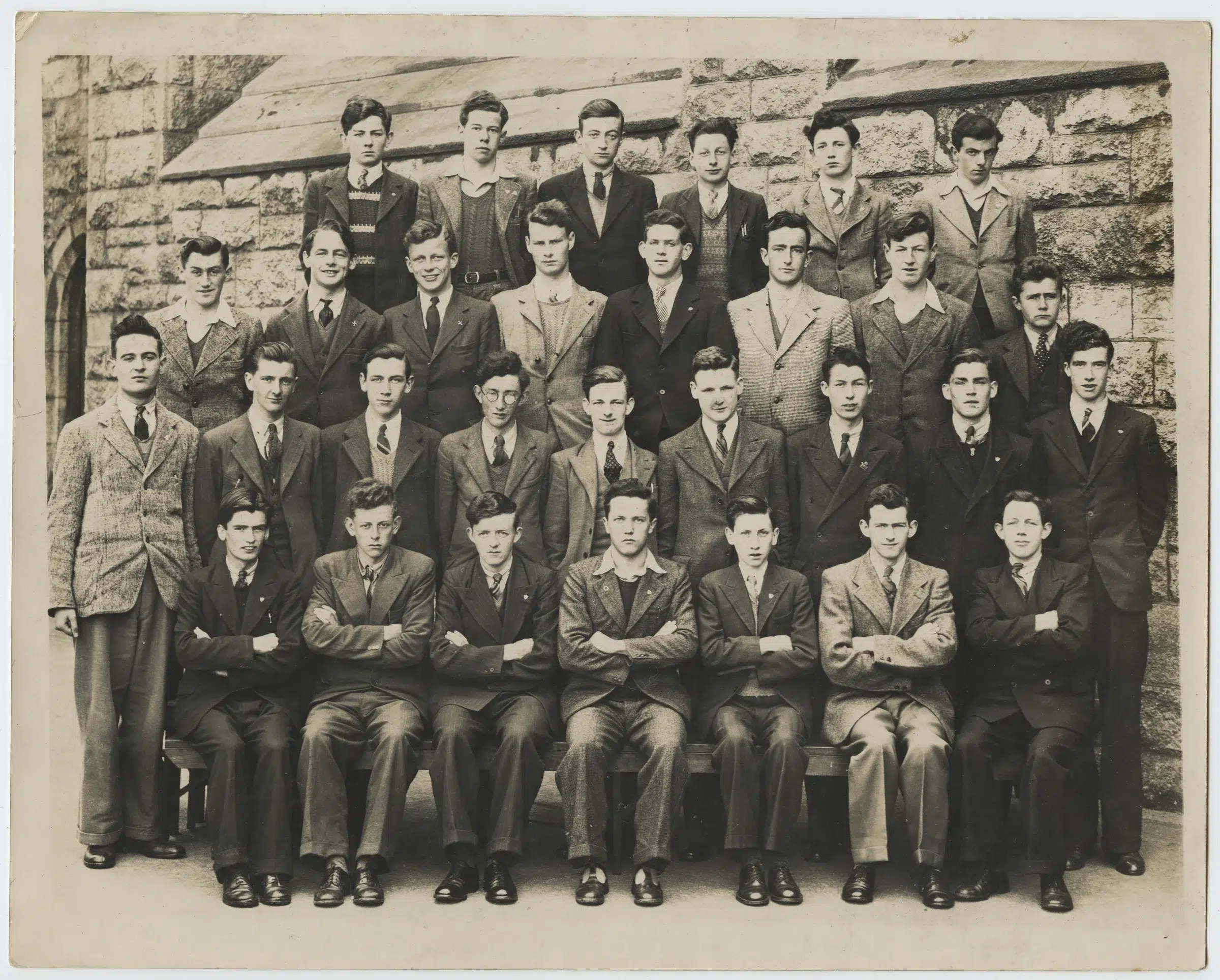
Its reverse carries the pencil inscription “Synge St Secondary School / 1946”. That is the basis of the present identification and dating. No list of pupils accompanies the photograph, and its maker is not identified. Those limits are part of the record: the surviving evidence establishes a school, a place and a year, but not the identities or later lives of the young men pictured.
Synge Street: a Dublin school founded in 1864
Synge Street CBS was founded in 1864, in a period when religious teaching orders were extending educational provision across Dublin. The school's own heritage account describes a Catholic secondary school for boys and a long institutional tradition associated with the Edmund Rice schools.1 Its history is rooted in the streets south of the city centre, rather than in an isolated campus: pupils, teachers, families and the surrounding neighbourhood formed overlapping parts of the school's life.
The institution was already more than eighty years old when the 1946 portrait was taken. The photograph is therefore not an image of a newly established school. It belongs to a mature Dublin educational community, one whose story crosses the final decades of British rule, the formation of the Irish state and the difficult years surrounding the Second World War.
Five years earlier: Keogh Brothers and the National Library record
A striking comparison survives in the National Library of Ireland's Keogh Photographic Collection. The Library catalogues a 1941 glass-plate negative of pupils of Synge Street, Christian Brothers School, Dublin, attributed to Keogh Brothers Ltd. and numbered Ke 308. Its recorded size is 16.5 × 12 cm.2 A companion negative, Ke 307, shows a teacher and pupils of the same school, also dated 1941.3
These are distinct photographs, not alternate copies of the 1946 print offered by Ten Bells Auction House. Nor does the Keogh attribution establish who photographed the later group. What the three records demonstrate together is the recurrence of formal school portraiture at Synge Street during the 1940s. One set survives as catalogued institutional negatives; the other survives as a physical print bearing its own handwritten identification.
That distinction matters historically. A negative held in a national collection and a print retained outside an institution have different routes into the present, yet both preserve evidence of a school community that otherwise appears only intermittently in the public photographic record.
Dublin school life at the end of the Emergency
The year 1946 followed the end of the European war and the period Ireland knew as the Emergency. The Irish Defence Forces' historical account treats 1939–46 as the Emergency period and describes the transition into the post-Emergency years.5 The boys in this portrait were photographed at that hinge in Irish history, though the image itself offers no evidence about any individual family's wartime experience.
Schooling was also far from universal at secondary level. A historical review published by the Central Statistics Office notes that, in the 1940s, church-controlled national schools provided most basic education, while fee-paying secondary education was available to a comparatively limited proportion of children. The same review records 35,000 children aged fifteen or younger in gainful employment in the 1946 census.4
Those national figures cannot tell us the circumstances of the young men in the Synge Street photograph. They do, however, prevent a school portrait from being mistaken for a picture of childhood as experienced by everyone. A formally dressed class group represents one visible part of a much more varied Irish educational landscape.
The institution outlasts its buildings
The school's own account of its facilities says that the present St Paul's building dates from the late 1960s.6 The 1946 photograph predates that phase of construction. It should not, without further architectural evidence, be used to identify a particular surviving wall or entrance; its stone backdrop is visible, but the precise camera position is not documented.
Another trace of the period appears in the school's record of former pupil Con Creedon, who attended from 1938 to 1943 and later established an educational trust.7 His documented attendance does not place him in the 1946 photograph. Rather, it illustrates how institutional histories can preserve some individual biographies while many classmates remain unnamed in surviving images.
The significance of a class without names
Irish photographic history is often told through the work of celebrated studio proprietors and the great collections of topographical views. Yet school groups belong to the same historical record. They show the visual conventions through which institutions represented themselves, and they preserve people whose names may never have entered a published history.
The National Library's photographic holdings range from studio portraits to political events and views of towns and landscapes.8 The 1941 Keogh negatives and the independently surviving 1946 print show why modest institutional photographs merit a place alongside those better-known subjects. Together, they give Synge Street's mid-century history a human scale without pretending to identify individuals who remain unknown.
Related material currently available
Synge Street Secondary School, Dublin — original group photograph, 1946 · €175 · original photographic print, recto and verso. The contemporary pencil inscription gives the image its specific institutional and chronological context. The print is offered intact, with its condition and documentary limits described in the catalogue record.
View the original photograph and full catalogue record → · Explore Antiquarian Irish Photography →
Sources and further reading
- Synge Street CBS, “Heritage” — the school's foundation in 1864 and institutional history.
- National Library of Ireland, Keogh Photographic Collection, Ke 308 — pupils of Synge Street, 1941.
- National Library of Ireland, Keogh Photographic Collection, Ke 307 — teacher and pupils of Synge Street, 1941.
- Central Statistics Office, That Was Then, This Is Now — historical overview of Irish education and 1946 census figures.
- Irish Defence Forces, “Defence Forces History” — the Emergency, 1939–46, and the post-Emergency period.
- Synge Street CBS, “Facilities” — the late-1960s St Paul's building.
- Synge Street CBS, “Con Creedon Educational Trust” — a documented pupil of 1938–43.
- Government of Ireland, National Library photographic databases — the scope of Ireland's photographic collections.