New York to Blackrock, 1906–1907: The Power Family Postcards and an Irish Atlantic Correspondence
Three New York picture postcards travelled to the same house in Blackrock, County Dublin. Their handwritten messages recover an ordinary family conversation across the Atlantic, while their printed views reveal the city that the correspondents wanted people at home to see.
A New York skyline, an Irish address
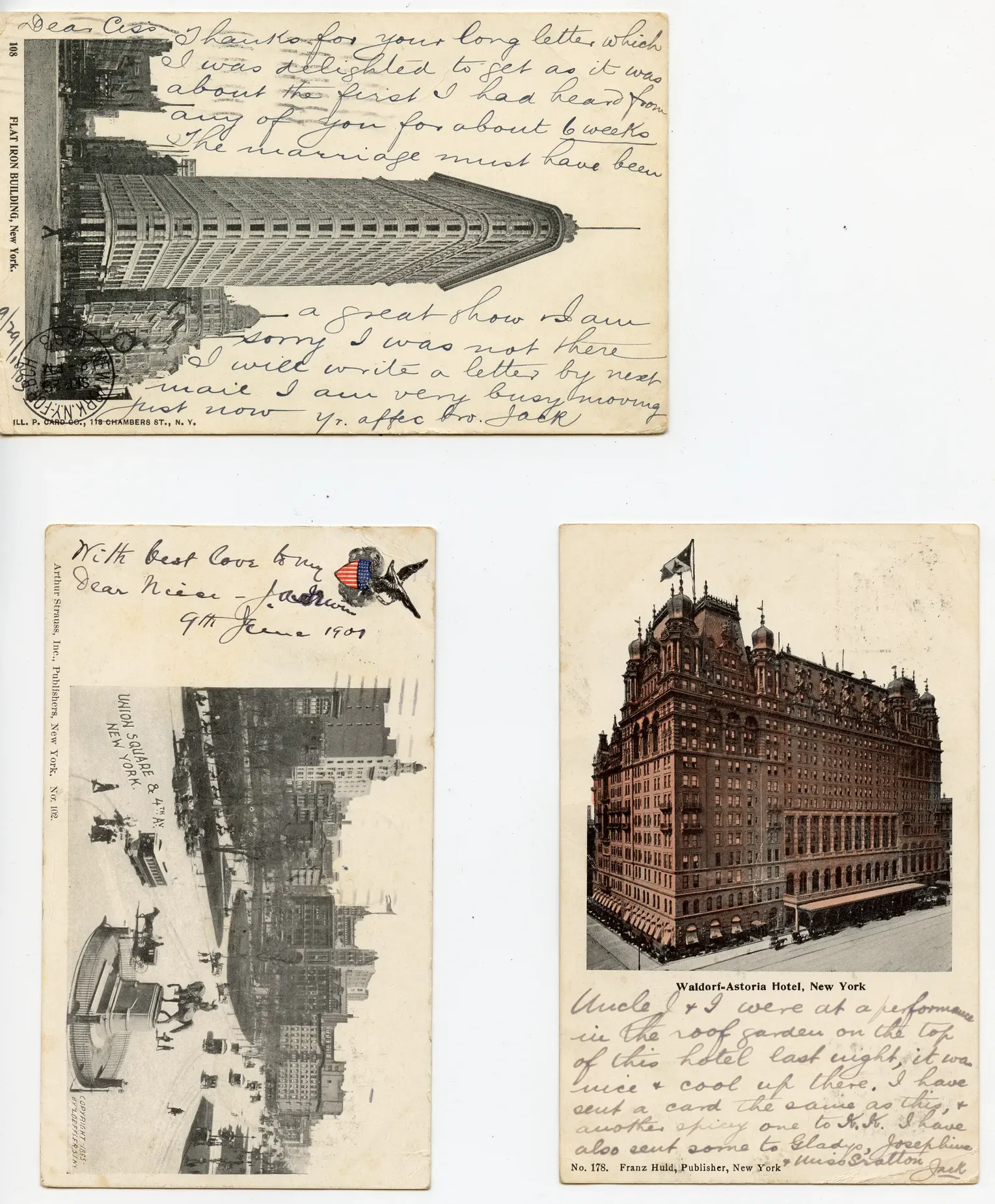
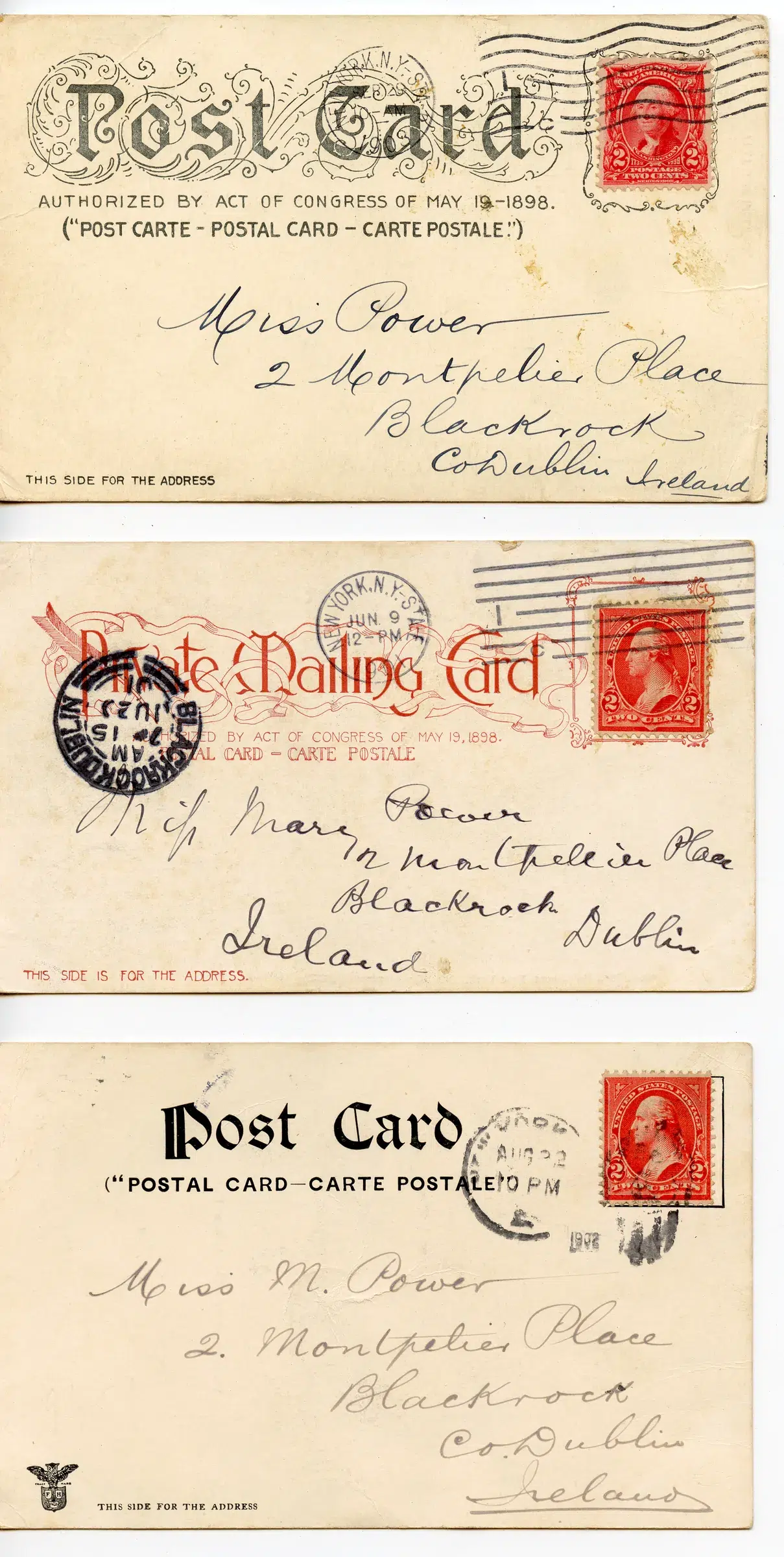
In 1906 and 1907, three small picture postcards crossed the Atlantic from New York to 2 Montpelier Place, Blackrock, County Dublin. They showed a startlingly modern American city: the wedge-shaped Flatiron Building, Union Square and Fourth Avenue, and the original Waldorf-Astoria Hotel. On the reverse, the address was repeated in different hands. On the illustrated face, relatives wrote about letters received, marriages, visits and a night out.
Read separately, the cards could be mistaken for souvenirs of familiar New York landmarks. Together, they form a modest but unusually coherent piece of Irish transatlantic family correspondence. They have a common destination, recurring recipients and at least two messages signed “Jack”. Their importance lies in that continuity: not merely three views of New York, but three occasions on which somebody there reached back towards a Dublin household.
The original group survives with its stamps, postal markings and handwritten messages. The full catalogue record preserves the inscriptions and distinguishes observed evidence from the family identifications proposed by later research.
“Dear Cis”: the private news that crossed the ocean
The Flatiron postcard begins “Dear Cis” and acknowledges a long letter, received after about six weeks without news of the family. Its writer refers to a marriage and signs himself as an affectionate brother, Jack. The image is public and architectural; the writing is intimate, concerned with the intervals between family letters and the ordinary worry that silence could create.
Another card, picturing the Waldorf-Astoria, mentions a performance in the hotel’s roof garden attended by Jack and “Uncle J.” The Union Square card, dated 9 June 1907, is addressed affectionately to a niece. Its signature is not sufficiently clear for a confident attribution. The recipients appear in varying forms as Miss Power, Miss Mary Power and Miss M. Power. That variation is itself a familiar feature of domestic post: the house and surname could be more reliable than a fully specified personal name.
The Smithsonian’s National Postal Museum describes how correspondence sustained families separated by migration, particularly between American cities and relatives abroad. The National Museum of Ireland places that separation within the longer history of Irish departures to North America. These sources establish the wider social setting, although the postcards alone do not prove that Jack had emigrated permanently, nor do they establish his occupation or precise journey.23
Such distinctions matter. A picture postcard is not an immigration record. What these three cards document securely is a family network, an American point of writing, an Irish point of receipt and the continued exchange of news.
The picture side: the city that New York sold to the world
Each view belongs to the commercial visual culture of Edwardian New York. The Flatiron Building, completed in 1902, was already an international emblem of the skyscraper age. The New-York Historical Society’s Thomas Holman Collection includes substantial groups of Flatiron postcards from the first decade of the century, demonstrating how rapidly the building became a repeatable and marketable image. In 1906, Edward Steichen’s atmospheric The Flatiron—Evening offered a very different artistic treatment of the same landmark.49
The Union Square card shows another kind of modernity: the city as traffic, public space and everyday movement rather than as a single architectural monument. Its June 1907 inscription is written across the picture, a reminder that the card was never intended to be a pristine city view. It was a message carrier whose image was part of the message.
The Waldorf-Astoria is especially evocative because the building depicted no longer exists. The original Waldorf Hotel opened in 1893; after its union with the adjoining Astoria in 1897, the combined hotel became a conspicuous symbol of metropolitan luxury. It was demolished in 1929, and the Empire State Building later occupied the site. The New York Public Library holds the original hotel’s records from 1893 to 1929. Against that documented background, Jack’s casual account of a roof-garden performance acquires an immediate setting: not a famous event, but an ordinary evening remembered through a celebrated building.5
Publishers such as Franz Huld supplied this international picture-postcard market. A 1906 Huld postcard in the New York Public Library offers an independently catalogued example of the same commercial genre. The three Blackrock cards preserve several publishers’ imprints, revealing how mass-produced urban images could become unique once addressed, stamped and written upon.6
2 Montpelier Place: a house with more than one history
Montpelier Place is a short historic terrace off the Blackrock road network, rather than one of Dublin’s monumental streets. The Dún Laoghaire–Rathdown County Council’s architectural conservation appraisal identifies the group’s early nineteenth-century character and records a plaque at No. 2 commemorating the death there, on 22 August 1882, of the writer and Irish Republican Brotherhood figure Charles J. Kickham. An independent Irish Times account likewise identifies the house’s literary and Fenian association.18
By 1906–1907, however, the address belonged to a different chapter. These postcards were directed to members of the Power household, not to Kickham. The house’s earlier association helps locate the correspondence in Blackrock’s layered history; it is not a provenance claim about the postcards.
Local genealogical research by June Bow and Karen Poff records a Power family connected with Montpelier Place, including John Irwin Power (born 1883) and Cecelia Mary Power (born 1885). Because “Jack” is a familiar form of John and “Cis” can be a familiar form of Cecelia, they are plausible correspondents. The cards’ language supports that reading, but does not prove it. Their identification should remain a reasoned attribution rather than a settled biographical fact.7
A family group, not three isolated views
Irish-American history is often told through ships, passenger lists, political organisations and major public events. Its more domestic texture survives in fragments: a remembered marriage, a delayed letter, a relative’s night at the theatre, the habitual address written for a household across the sea. The National Museums Northern Ireland preserves a 1906 postcard showing emigrants departing Queenstown, a visual reminder of the Atlantic journeys that formed the background to such correspondence. That image does not identify the Power family’s route, but it belongs to the same historical moment.10
The three cards survive together, retaining the link between their printed scenes and private handwriting. To detach the Flatiron view from its address and its accompanying cards would preserve a recognisable image of New York while losing much of the evidence that makes it Irish historical material. As a group, they document both the commercial circulation of American images and the less visible circulation of family news to Blackrock.
That is the larger significance of this small correspondence. Its participants were not writing for posterity. Yet the cards leave an unusually exact meeting point between a changing New York and a particular Dublin home, during two years in which the Atlantic was a distance crossed repeatedly by words, images and memory.
Related material currently available
Power Family — three original New York-to-Blackrock picture postcards, 1906–1907 · €145 · one complete three-card correspondence group. The Flatiron Building, Union Square and original Waldorf-Astoria appear on the picture sides; the original messages, stamps and repeated address at 2 Montpelier Place make the group a documentary record of Irish family life across the Atlantic. Offered intact, not divided into individual postcards.
View the original postcards, full photographs and condition report → · Explore Irish Ephemera & Manuscripts →
Sources and further reading
- Dún Laoghaire–Rathdown County Council, Montpelier Place Architectural Conservation Area Character Appraisal (2013) — Official record of the terrace and Charles J. Kickham’s death at No. 2 in 1882.
- National Museum of Ireland, Irish Emigration to America: The Journey — Background on Irish departures, family separation and Atlantic migration.
- Smithsonian National Postal Museum, An Explosion of Mail — The role of letters and cards in maintaining transatlantic immigrant family ties.
- New-York Historical Society, Thomas Holman Collection of Flatiron Building Photographs and Ephemera — Archival description of the Flatiron postcard trade, particularly c.1903–1913.
- New York Public Library, Waldorf-Astoria Hotel Records, 1893–1929 — History of the original Fifth Avenue hotel, including its 1929 demolition.
- New York Public Library Digital Collections, New York City Skyline, 1906 (Franz Huld) — Period example of New York postcard publishing by Franz Huld.
- June Bow and Karen Poff, Power Family of Netley, Stillorgan Genealogy & History — Local genealogical research on the Power family; tentative identities are not independently confirmed.
- The Irish Times, Townhouse in Blackrock for €900,000 (2014) — Independent account of the historic house and its connection with Kickham.
- Library of Congress, The Flatiron—Evening, Edward Steichen, 1906 — Contemporary visual record of the Flatiron Building’s prominence in the New York imagination.
- National Museums Northern Ireland, Emigrants Departing from Queenstown, Co. Cork, 1906 — A contemporary postcard of Atlantic departures from an Irish port.