
The Meyerhof Family Archive: A German-Jewish Family Between Berlin, the Mediterranean and Argentina
The Meyerhof archive survived not as a curated historical collection but as a family accumulation: photographs, negatives, letters, postcards, documents and original packets that still retain their internal relationships. Across 392 recorded components, ordinary family life, Mediterranean travel, scientific work and the pressure of migration meet in one coherent documentary body.
An archive that arrived in a biscuit tin
The Meyerhof Family Archive came into private hands in Ireland approximately twenty years ago, preserved together in an old German biscuit tin. That detail is modest, but historically important. The group was not assembled by a dealer from separate purchases; its prints, negatives, envelopes, letters and documents survived together before acquisition and have remained together since.
The working inventory now records 392 physical archival components: 94 original photographic prints, 258 negatives, 21 original packets or envelopes, 12 postcards, four letters and two documents. Some prints correspond to surviving negatives, so the count is not a claim for 392 unique images. The value lies in the survival of the relationships between them.
Those relationships are often where archives become legible. A name written on a packet may connect a run of negatives to a journey. A dated letter can explain why a family photograph suddenly shifts continent. A laboratory image can acquire context when a scientific publication confirms that two names appearing elsewhere in the archive actually worked together.
Before catastrophe: Berlin, Italy and ordinary life
The chronology begins in Berlin in 1927 and then moves through Italy and neighbouring regions: Rome, Milan, Lago Maggiore, Como and Lugano, the Stelvio area, Venice and Paris. Original packet associations preserve names and dates, including a Paris packet marked “Meyerhof”, an April 1933 Rome group associated with Werner, a 1934 travel group and a 1936 Milan packet marked “Sig. Meyerhof”.
It is important not to read every pre-war Jewish family archive backwards only through persecution. These photographs also preserve holidays, travel, friendships, scientific curiosity and the ordinary visual habits of an educated European family. That ordinary life is part of the historical evidence.
Precisely because we know what followed, the photographs can feel fragile. But the archive is strongest when the later history does not erase the earlier one. It shows people moving through Europe before borders, visas and guarantees became matters of survival.
The S.S. Tel Aviv: a ship inside the archive
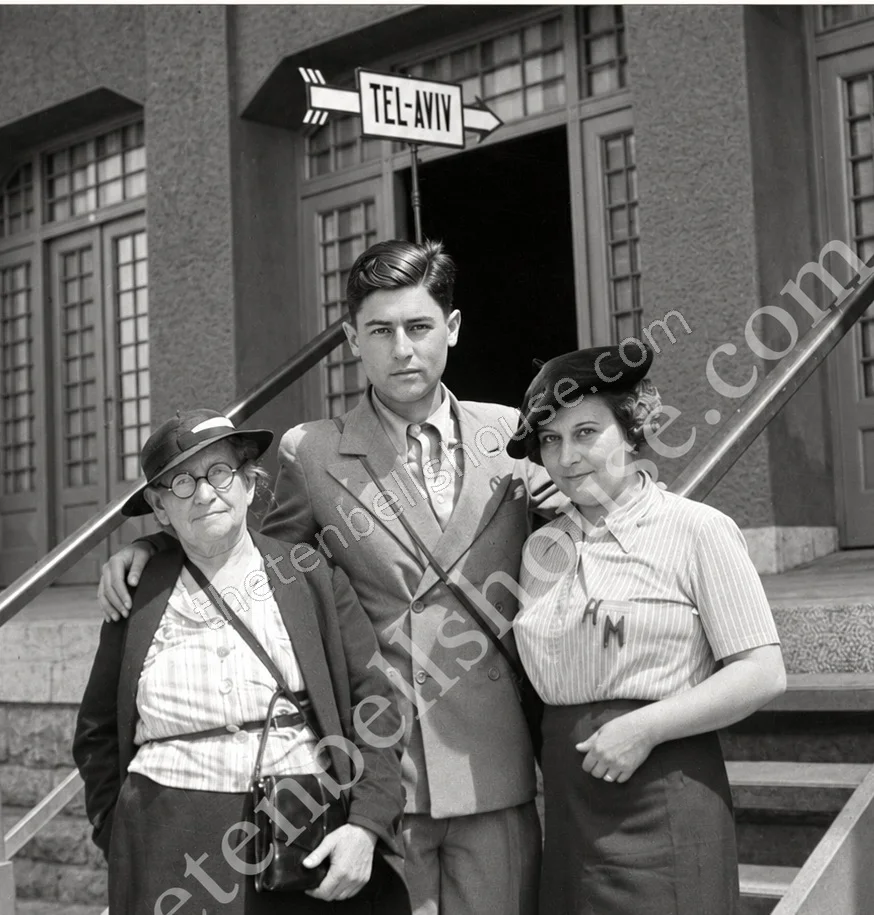
One of the most striking groups is a multi-frame maritime sequence marked “Sommerreise – Juli 1935” and connected with the S.S. Tel Aviv. The surviving negatives include the vessel, deck scenes, passengers and embarkation views.
Independent sources confirm the ship’s unusual historical setting. The Jewish Museum Berlin preserves passenger lists and schedules for the S.S. Tel Aviv, operated by the Palestine Shipping Company on the Trieste–Haifa route in 1935. Contemporary reports describe the company as a Jewish enterprise and the ship as part of a new regular connection between Europe and Mandatory Palestine.
The archive does not, by itself, identify every passenger in its photographs, and the public record deliberately avoids doing so. What it does preserve is something rarer than a publicity postcard: a private photographic sequence made during the very period in which this route was operating.
Science in the family record
The Meyerhof material also contains scientific and medical photographs, biological drawings and laboratory-related images. Here external bibliography provides an important point of confirmation. In 1940, H. L. Meyerhof and A. Zironi published “The action of embryonic extracts on the sex organs” in The Journal of Physiology.
That publication establishes a genuine scientific association between Meyerhof and Zironi. It does not automatically identify every person in the archive’s laboratory photographs. The distinction matters: a responsible catalogue can use the paper to confirm a professional relationship without turning that relationship into unsupported face identification.
This is a useful example of how archival research should work. A photograph suggests a line of enquiry; independent sources confirm part of the context; and the final description keeps the confirmed fact separate from the remaining hypothesis.
November 1938: correspondence becomes migration evidence
By late 1938 the character of the surviving material changes. Letters from Banfield, Argentina discuss practical questions of migration: permission, financial guarantees, consular procedure and visas. The details are administrative, almost bureaucratic. That is precisely what gives them historical force.
The broader context is well documented. The United States Holocaust Memorial Museum notes that the events of 1938 caused a sharp rise in Jewish emigration from Germany while immigration restrictions elsewhere made refuge increasingly difficult. Jewish Museum Berlin likewise emphasises that after the November pogroms the refugee wave reached its peak at the same moment that receiving countries were tightening entry conditions.
Argentina was one of the destinations that mattered. USHMM records that the country admitted tens of thousands of Jewish immigrants between 1933 and 1943, while also imposing restrictions that left many families dependent on documentation, guarantees and informal routes. Against that background, the Banfield letters cease to look like incidental family correspondence. They become evidence of how migration was actually negotiated at household level.
Packets, handwriting and the architecture of memory
Twenty-one original photographic packets or envelopes survive with the archive. They may appear less visually important than the photographs inside them, but they are among the most valuable components for research. Packet titles preserve names, journeys and groupings that would otherwise disappear.
Among them are the Paris “Meyerhof” group, travel packets connected with Werner, a 1936 Milan group and a 1937 Venice sequence. The archive has therefore been catalogued by respecting those original associations wherever possible rather than flattening the material into a single chronological image bank.
This is also why the archive will not be broken. Detached, an attractive 1935 ship photograph might become “Jewish passengers on a liner”; a scientific image might become “laboratory, Europe”; a family portrait might become “unidentified German family”. Together, they retain the possibility of reconstruction.
An archive of movement, not a collection of isolated subjects
The Meyerhof archive crosses several fields that institutions often collect separately: German-Jewish family history, migration and refugee history, vernacular photography, maritime history, inter-war Italy, medicine and science. Its significance comes from the fact that those subjects are not separate here. They belonged to the same lives.
The archive moves geographically from Berlin across Italy and France, through the Mediterranean, to Argentina. Its later research trail extends beyond the primary 1927–1938 material. But the public presentation remains selective: documented facts, plausible attributions and unresolved questions are kept visibly distinct.
The collection is offered only for institutional acquisition and is maintained as one undivided fonds. Museums, libraries, archives and recognised research institutions may request the full inventory and research dossier.
What survives between the photographs
The strongest archives are often held together by the least glamorous objects: an envelope, a caption, a postmark, a handwritten place name, a list of visa requirements. The Meyerhof material demonstrates why those things matter. History is not only inside the best photograph. It also survives in the relationships that explain why the photograph was kept.
Related archive record
The Meyerhof Family Archive — institutional catalogue record →
The catalogue record gives the archive-level inventory, representative images, research status and institutional acquisition information.
Sources and further research
The Meyerhof archive itself supplies the primary evidence for names, packets, photographs and correspondence described in this essay. The following external sources support the wider historical context.
- H. L. Meyerhof & A. Zironi, “The action of embryonic extracts on the sex organs”, The Journal of Physiology 97 (1940) — confirms the scientific collaboration.
- Jewish Museum Berlin — passenger list of the S.S. Tel Aviv, 1935 — documents the Palestine Shipping Company and the Trieste–Haifa route.
- Jewish Museum Berlin — schedules and travel information for the S.S. Tel Aviv — historical context for the line and vessel.
- Jewish Telegraphic Agency, 14 January 1935 — new Palestine shipping line — contemporary report on the company and planned Haifa–Trieste service.
- United States Holocaust Memorial Museum — German Jewish Refugees, 1933–1939 — context for the rapid increase in emigration and visa applications during 1938.
- United States Holocaust Memorial Museum — Refuge in Latin America — context for Jewish immigration to Argentina and regional restrictions.
- Jewish Museum Berlin — Emigration / Exile — German-Jewish emigration and the tightening conditions after November 1938.