Florence Austral at the Dublin Gaiety, 1939: A Wagnerian Voice at the End of an Era
In the first winter of the Second World War, a Dublin theatre programme advertised five operas, a celebrated Australian soprano and a dense network of local businesses. It survives at the intersection of an international musical career and the ordinary printed life of the city.
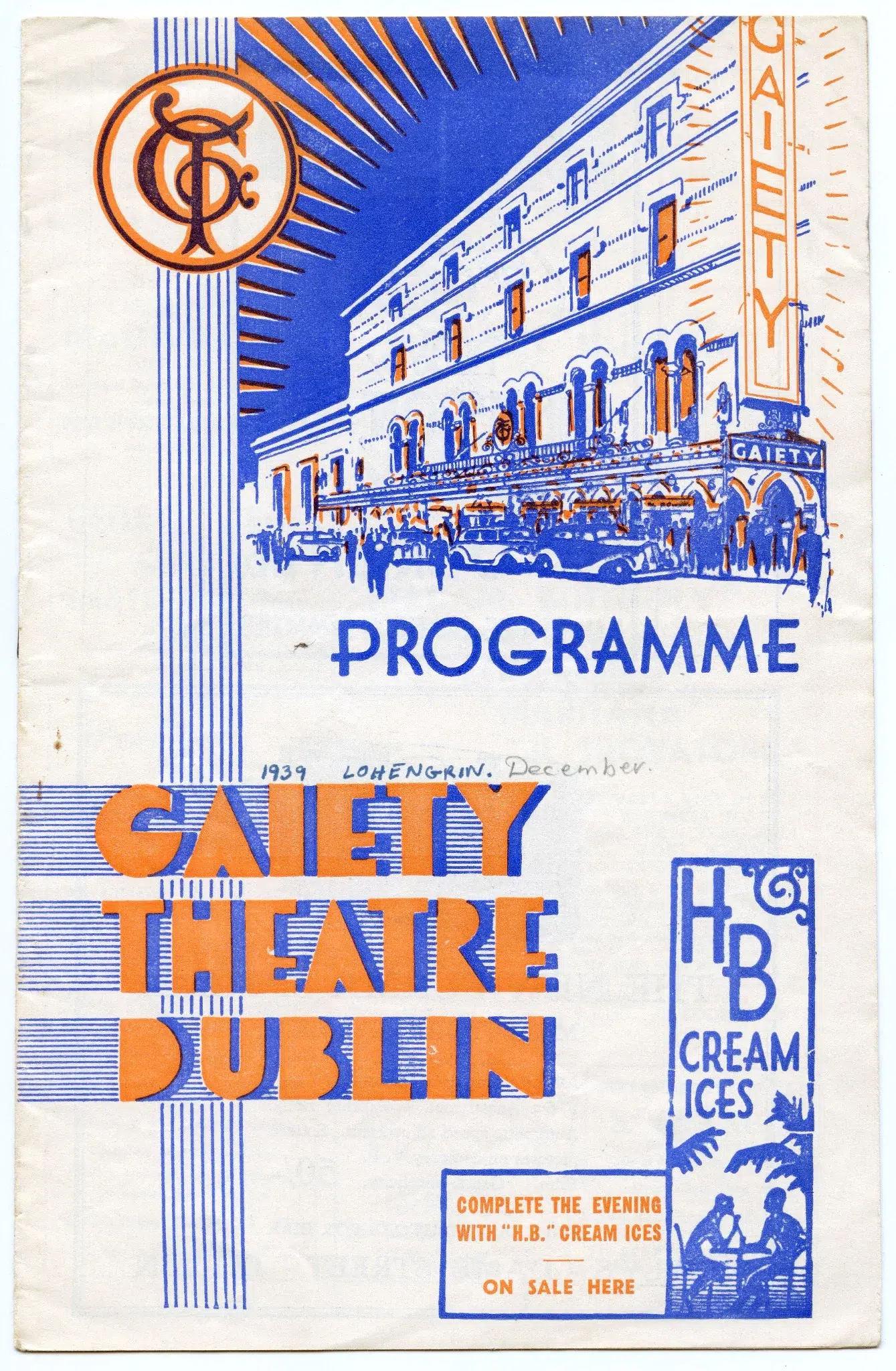
A programme from the first wartime winter
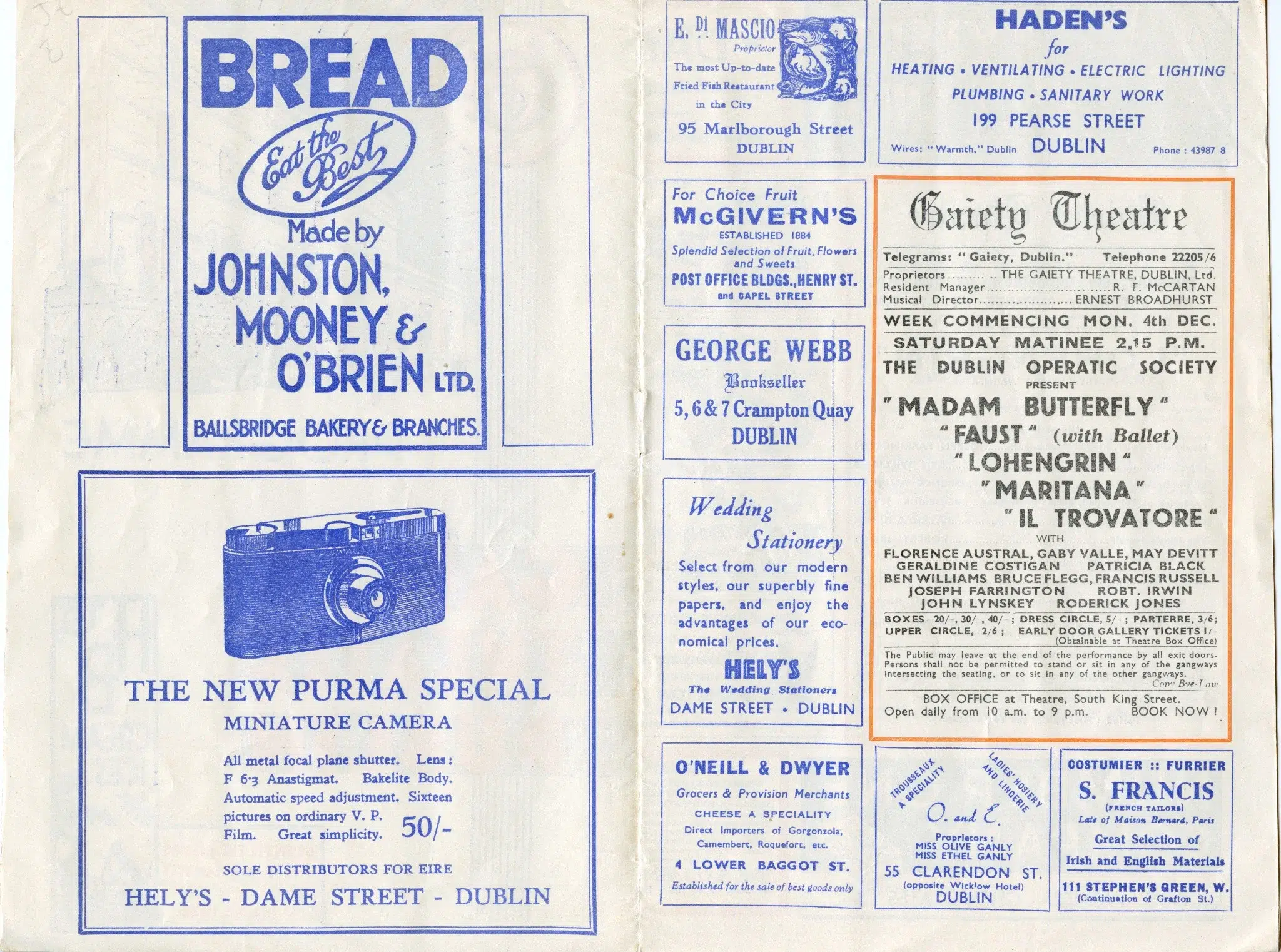
On the inside of a folded programme for Dublin’s Gaiety Theatre, an orange-framed announcement names the Dublin Operatic Society and its week beginning Monday, 4 December 1939. It advertises Madam Butterfly, Faust, Lohengrin, Maritana and Il Trovatore. Beneath the repertoire appears a distinguished list of artists, led by Florence Austral. The surrounding page is filled with advertisements for Dublin booksellers, grocers, a restaurant, a camera and household services.
The document is an unusually compact witness to cultural life in Ireland at the opening of the war. The international situation was transformed, but this sheet still offered a full programme of music in South King Street, prices for the different parts of the auditorium and the ordinary commercial assurances of a functioning city. The Gaiety had opened in 1871 and had long presented opera alongside drama and other entertainments. By December 1939 it was a familiar civic institution, not a new experiment.1
The surviving original is described and illustrated in Ten Bells Auction House catalogue record for the December 1939 Gaiety programme. The printed season announcement is primary evidence for what was advertised; it should not be mistaken for a complete attendance register or a performance-by-performance cast sheet.
Florence Austral: from Melbourne to the Wagner stage
Florence Austral was born Florence Mary Wilson in Richmond, Melbourne, in 1892. She took a stage name that made her Australian origins unmistakable. After studies and early concerts, she established herself in Britain and made a notable operatic debut in 1922 as Brünnhilde in Wagner’s Die Walküre. Her reputation rested above all on the scale and colour of her dramatic soprano voice, particularly in Wagner, although her repertoire also extended to other composers. The National Portrait Gallery of Australia and the Australian Dictionary of Biography trace her international career, recordings and later teaching.3
Her Dublin appearances belong to the closing phase of that career. According to Live Performance Australia’s historical profile, Austral sang with the Dublin Operatic Society in 1938 and returned for Lohengrin in 1939. The profile identifies that Dublin engagement as her last appearance in opera. This is a substantial claim, but it is not an assertion that every date or role in the surviving programme can be independently reconstructed from this one piece of paper.2
That distinction gives the document its value. A mass-produced programme, intended to be read for a few hours and then discarded, can unexpectedly anchor a turning point in a singer’s biography. It does so not because the printer knew it was marking a farewell, but because subsequent historical research gives meaning to the otherwise routine list of names.
Five operas, one Dublin company
The December programme names a broad repertoire. Wagner’s Lohengrin appears beside Puccini’s Madam Butterfly, Gounod’s Faust, Wallace’s Maritana and Verdi’s Il Trovatore. The specialist Opera in Ireland archive independently records precisely those five titles for the Dublin Operatic Society’s autumn 1939 season, under producer Sydney Russell. Its reconstruction draws on programmes, period reviews and other surviving performance evidence.4
Such a programme also reveals the mixed character of the company. Internationally recognised visiting performers appeared alongside singers strongly associated with Dublin’s own operatic life. The printed names include May Devitt, Geraldine Costigan, Patricia Black, Bruce Flegg, Robert Irwin and John Lynskey, as well as Austral. These are not merely supporting names beneath a visiting star: they are part of the local infrastructure that made a season possible.
The specialist record for Madama Butterfly identifies performances on 30 November and 6 December 1939, including a broadcast of the latter on Radio Éireann. It also preserves a contemporary Dublin review of May Devitt’s performance. That separate evidence is a useful reminder that the programme belongs to a season extending beyond the single printed week, and that the operatic experience circulated by radio as well as inside the theatre.5
The society named on the 1939 sheet was the Dublin Operatic Society. It should not be silently conflated with the later Dublin Grand Opera Society, established in 1941. That distinction matters when searching archival catalogues, since the two organisations occupy overlapping but different chapters in Dublin’s operatic history.
Dublin’s Gaiety during the Emergency
When the programme was issued, Ireland had entered the period commonly known as the Emergency. The state remained neutral in the European conflict, while emergency powers, economic pressures and uncertainty shaped public life. The edited Documents on Irish Foreign Policy, volume six establishes the precarious setting of late 1939, and the Military Archives documents the censorship machinery established under emergency legislation.910
The Gaiety programme does not tell us how any particular audience member felt about the war. Nor does it establish how ticket sales or travel arrangements were affected. What it shows, more securely, is that opera continued to be advertised as a public event in Dublin in December 1939. Its box-office hours, prices and Saturday matinee notice speak to the routines that continued alongside extraordinary events.
For the history of the city, this is as important as the celebrated soprano’s name. An evening at the opera was a social occasion, a commercial undertaking and a form of shared public culture. The paper programme was one of the places where those functions met.
What the advertisements remember
Almost as much space is given to commerce as to opera. The left-hand page carries a large notice for Johnston, Mooney & O’Brien’s bread and an illustrated advertisement for the Purma Special miniature camera, offered through Hely’s of Dame Street. Nearby are notices for E. Di Mascio’s restaurant on Marlborough Street, Haden’s of Pearse Street, McGivern’s on Henry Street, bookseller George Webb at Crampton Quay and O’Neill & Dwyer on Lower Baggot Street.
The camera advertisement is especially revealing. A theatre programme became a vehicle for selling photography equipment, showing how closely leisure, visual technology and urban retail overlapped. Its printed price and technical promises belong to the period’s commercial language. The advertisement is not evidence that the camera was used to photograph the performance; it is evidence of the consumer goods promoted to the audience attending it.
The object also records a local printing trade. The catalogue identifies Hely’s Limited, East Wall, Dublin as the printer. A separate National Library of Ireland record for a 1943 Gaiety programme likewise names Hely’s Limited at East Wall and notes the presence of numerous Dublin advertisements. That later comparison demonstrates a continuing relationship between theatre printing and the city’s commercial pages without implying that the two programmes are identical.8
Other Irish repositories preserve this class of material. The National Library of Ireland explicitly collects theatre programmes, playbills and similar ephemeral publications, while the National Gallery of Ireland catalogues a file of Gaiety playbills from 1922 to 1945. These collections underline why disposable printed matter deserves serious historical attention: a programme may be the surviving record of a performance, a business address or an otherwise unrecorded everyday exchange.67
A small document with several histories
Florence Austral’s Dublin Lohengrin is remembered because it marked the end of an important operatic career. Yet the December 1939 programme is more than a souvenir of one singer. It is also evidence of the Dublin Operatic Society’s repertory, the Gaiety’s continued place in city life, the businesses that advertised to its audience and the printers who supplied its paper world.
These layers explain why original Irish theatre ephemera can matter beyond the stage. A single folded sheet preserves cultural history and commercial history together. For a related Dublin venue, the Journal also examines the short-lived Torch Theatre on Capel Street; the contrast makes clear how different institutions left different kinds of documentary traces.
Related material currently available
Dublin Operatic Society — Gaiety Theatre programme, December 1939 · Original four-page colour-printed programme · €125 in the latest prepared catalogue.
The sheet advertises Florence Austral and Lohengrin, reproduces the season’s other four operas, and retains Dublin commercial advertisements and its original printed design. The connection to Austral’s final operatic engagement is supported by independent biographical research; the item is offered as the original period programme, not as a signed or personally owned Austral document.
Examine the original programme and its condition → · Explore Irish ephemera and manuscripts →
Sources and further reading
- Gaiety Theatre, “About / History” — The theatre’s own history, including its 1871 opening and place in Dublin opera and drama.
- Live Performance Australia, “Florence Austral 1892–1968” — Frank Van Straten’s career profile, specifically identifying the 1939 Dublin Lohengrin as her final appearance in opera.
- Australian Dictionary of Biography, “Austral, Florence Mary (1892–1968)” — Thérèse Radic’s biographical entry on Austral’s international career.
- Opera in Ireland, “Sydney Russell” — A specialist repertory chronology documenting the Dublin Operatic Society’s five autumn 1939 works.
- Opera in Ireland, “1939 / Madama Butterfly / Puccini” — Season details, including the December 6 performance and a contemporary newspaper review.
- National Library of Ireland, “Ephemera” — The institutional context for preserving Irish playbills, programmes and other short-lived print.
- National Gallery of Ireland, “Playbills of productions at the Gaiety theatre, Dublin” — Archive record of a file of Gaiety playbills dated 1922–1945 in the Yeats-related holdings.
- National Library of Ireland, “Gaiety Theatre Dublin Programme” (1943) — A later Gaiety programme catalogued with Hely’s Limited, East Wall, as printer and numerous Dublin advertisements.
- Documents on Irish Foreign Policy, Volume 6, Introduction — Scholarly edited primary-source collection establishing the international and domestic setting of September 1939–January 1941.
- Military Archives, “Office of the Controller of Censorship (1939–1945)” — Archival context for emergency powers and wartime censorship in neutral Ireland.
Primary object: Ten Bells Auction House, catalogue record TBH-IRL-EPH-GAIETY-1939-12, original folded Gaiety Theatre programme for the week commencing 4 December 1939. Printed evidence and subsequent historical interpretations are distinguished in the text.